
Advancing Equity
The League of California Cities doesn't just advocate for the common interest of cities. It also helps city officials lead on challenging issues their communities face by providing education and resources that focus on promising strategies and new solutions. In June 2020, the Cal Cities Board of Directors issued a statement committing to the creation of an equitable and just future for all Californians. Cal Cities is dedicated to supporting its members by connecting them to resources and educational opportunities that strengthen their knowledge and capacity to eliminate racial disparities, heal racial divisions, and build more equitable communities. Below, is a list of foundational resources, which will grow as we deepen our knowledge and breadth in this space.
Advancing Equity Community
We are excited to announce the Cal Cities Advancing Equity Community where members can connect with one another to share information and resources. The new tool enables city officials to post information, give feedback, share resources, and interact with other city leaders on diversity, equity, and inclusion within cities. This community is open to all Cal Cities members. If you have any questions or need assistance, please contact Meghan McKelvey. Sign up now >
Equity Roadmap

Resources for Cities
2026 Equity Related Conference Sessions:
- City Leaders Summit
- April 23, 2026: What California Cities are Doing to Support Homeless Veterans
- April 23, 2026: Building Family-Friendly Cities: Child Care as Critical Infrastructure
- April 23, 2026: Local Government and Immigration Enforcement: Policy, Practice, and Community Impact
- City Managers
- Feb. 11, 2026: Keynote: Protecting the Vulnerable: A Conversation on Policing for City Managers
- Feb. 12, 2026: From the Ground Up: Women City Managers on How They Got to the Top
- Feb. 13, 2026: Women Leading Government Roundtable
- Public Works Officers Institute
- Feb. 26, 2026: Women in Public Works Roundtable
- Past equity-related Annual Conference Sessions
- United Against Hate (October 18-24, 2026)
Free to watch
- Advancing Racial Equity: An Introduction - Cal Cities and the National League of Cities REAL Department set the stage for the work necessary to expand city leaders' knowledge and capacity to eliminate racial disparities, heal racial divisions, and build more equitable communities. Cal Cities webinar originally offered Aug. 27, 2020.
- Advancing Racial Equity: A Discussion - Cities across the nation are grappling with frustration, outrage, and grief stemming from the effects of systemic racism. Join leadership from the National League of Cities REAL Department and three California city leaders for a discussion on how they are building more equitable and just cities. Keynote panel discussion originally offered at the League of California Cities Annual Conference and Expo on Oct. 8, 2020.
Learn from other cities in Western City's magazine
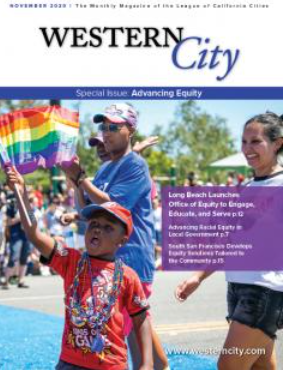
 Western City magazine highlights efforts to address systemic inequities in city institutions and policies and replace them with systems that are inclusive and fair. Western City Articles can be found here.
- NLC REAL: The National League of Cities (NLC) Race, Equity, and Leadership (REAL) program was established in the wake of the 2014 unrest in Ferguson, Missouri, to strengthen the capacity to build more equitable communities. The REAL department offers tools and resources that help local elected leaders build safe places where people from all racial, ethnic, and cultural backgrounds thrive socially, economically, academically, and physically. Please refer to the following reading list:
- Municipal Action Guide: Advancing Racial Equity in Your City compiles six immediate steps for improving outcomes for all residents.
- Municipal Action Guide: Responding to Racial Tension in Your City provides important contextual and tactical information to support your municipality’s efforts to respond effectively.
- Repository of City Racial Equity Policies and Decision includes examples of concrete policy and budgetary changes local elected officials have made to prioritize racial equity in their cities and towns.
- Government Alliance on Race and Equity (GARE) Public resources include:
- Resource Guides
- Toolkits
- Issue Papers
- Public Program Recordings
- Communications
- https://www.racialequityalliance.org/resources/gare-resources
- Racial Equity Resolution provides a template and talking points that explain why pursuing equity is good for local government.
- The City Leader’s Compass to the My Brother’s Keeper Landscape offers resources for city leaders working to respond to the My Brother’s Keeper Community Challenge. This publication highlights a comprehensive set of steps cities can take to tackle disparities, change systems, and improve outcomes for boys and young men of color.
- GARE: The Government Alliance on Race and Equity (GARE) is a national network of government working to achieve racial equity and advance opportunities for all. GARE supports jurisdictions that are at the forefront of work to achieve racial equity; develops a “pathway for entry” into racial equity work for new jurisdictions; and builds local and regional collaborations that are inclusive and focused on achieving racial equity.
- Race Forward: Race Forward brings systemic analysis and an innovative approach to complex race issues to help people take effective action toward racial equity. The organization conducts original research on pressing racial justice issues ranging from immigration to economic inequality.
- ICMA Race, Equity, and Social Justice: Materials curated by the International City Managers Association (ICMA), along with reports and surveys that describe approaches that have an impact and provide the opportunity to learn from the experiences of others.
- Mayors and Business Leaders Center for Compassionate and Equitable Cities: Resources, including ideas, initiatives, toolkits, and reports, by mayors and for mayors and other city leaders.
The federal shutdown put SNAP funding in limbo. California cities stepped up to fill the gap
Jackie Krentzman is a Bay Area-based writer and editor. Additional research contributions by Caleb Zimmerschied Valadez, freelance writer, Karina Rodriguez, Cal Cities digital media producer, and Cal Cities regional public affairs managers.
At the start of November, 5.5 million Californians — including 3.5 million seniors and children — temporarily lost access to CalFresh, known federally as the Supplemental Nutrition Assistance Program (SNAP), due to the federal government shutdown.
Although the government is on the brink of reopening, a series of competing court orders has sown confusion over SNAP benefits. And community advocates are warning that the crisis could linger, as food banks are now short on stock and food orders are delayed.
Counties and nonprofits are typically on the frontlines of food insecurity, but many California cities are responding as well. Almost every city is sharing resources with its residents about county and nonprofit food banks they can access. Some cities, such as South San Francisco, Mammoth Lakes, and Riverside, are directly funding food insecurity programs.
“We are not immune to what’s happening in Washington, D.C., but we are not powerless,” South San Francisco Mayor Eddie Flores said. “It’s a moment like this that requires us to lead.”
The state has also released $80 million to support food banks, and Gov. Gavin Newsom has sent the California National Guard to help food banks pack and distribute food.
“From low-income residents to members of our military, there are suddenly thousands of Riverside residents who now are in danger of going hungry,” Mayor Pro Tem Chuck Conder said of Riverside’s $100,000 allocation. “This program is designed to supplement their nutritional needs until a broader solution can be worked out at the federal level.”
Other cities are marshalling their resources and leveraging partnerships. San Diego partnered with a local food bank and San Diego State University to host an emergency food distribution event supporting more than 2,000 city residents. Sonoma is co-sponsoring a “Food & Funds Drive” at its city hall this coming weekend. Irvine will hold an emergency food drive in mid-November.
“We won’t let the gridlock in D.C. stop us from doing the right thing here at home,” San Diego Mayor Todd Gloria said in a post on Instagram.
Cities are finding creative ways to stretch their dollars to help. West Hollywood is working with the nonprofit Farm Habit to provide $15 in shopping credits to customers with a $0 EBT balance during the disruptions. Merced has placed food donation bins throughout the city. San Jose is exploring ways to set up hubs to assist Santa Clara County and nonprofits with their food distribution. Stockton council members are even volunteering at food banks.
Fresno Council Member Nelson Esparza last week called the conditions “truly heartbreaking.” The city voted a few days later to send $250,000 to Central California’s largest food bank.
“The horrifying reality is there are still families ... who will go to the grocery store and find out the hard way that those benefits were not renewed for this month,” he said at a press conference.
Others are amplifying the work of their nonprofit partnerships, which some cities fund, such as in Santa Monica and Irvine. Santa Monica has partnered with a local food bank to add food donation boxes throughout the city. Irvine is advertising its free monthly grocery boxes on its social media channels, along with its free school breakfast and lunch programs.
The effects have not been felt equally. Many rural cities are struggling to help hungry residents, as they often don’t have the resources of larger cities. For example, 27% of residents of Tulare and Imperial Counties had their benefits cut off, nearly double the statewide average.
Other counties with a high percentage of SNAP recipients include Fresno, Kern, Lake, and Del Norte counties.
Galt, a rural city in Sacramento County, doesn’t have the resources to provide emergency food assistance for its 3,000 impacted residents. The city is coordinating with the county and sharing information about available resources through its social media channels, newsletter, and website.
“We are encouraging community support by providing direct links where residents can donate to our local food banks,” Assistant City Manager Amie Mendes told Cal Cities. “Galt is a small, tight-knit community where neighbors take care of one another. We are confident that our residents will continue the long-standing tradition of giving and supporting one another in times of need.”
The action taken may be varied, but California cities are united in their vow to help their constituents who lost their SNAP benefits.
“No family should have to scrape by or wonder when their next meal will be,” Fresno’s Esparza told Fox26News. “If the federal safety net falters, we have an obligation to strengthen our local apparatus. This is about taking steps to combat the forthcoming food insecurity that is happening as a result of the federal government shutdown.”
Leave a comment